

.svg%20(1).png)


Key Takeways
- Two-Factor Authentication enhances security by requiring two authentication factors, like passwords and mobile devices.
- Despite benefits, 2FA has drawbacks such as user inconvenience, device dependency, and vulnerability to phishing.
- Multi-factor authentication goes beyond 2FA by using more than two factors, providing stronger multi-layered security.
- MFA offers increased security, reduces phishing success, and improves user experience with flexible methods.
- Businesses are shifting from 2FA to MFA, with studies showing MFA blocks 99.9% of account compromise attacks.
- Platforms like Verify Now helps businesses implement MFA by enabling SMS verification.
The Ponemon Institute report explained that breaches caused by stolen or compromised credentials totalled an average cost of USD 4.50 million.
These breaches also tended to have the longest lifecycle. On average, it took 243 days for staff to be able to identify the breach, and then a further 84 days to contain the breach.
To overcome such mishaps and security breaches two-factor authentication (2FA) has been one of the most commonly used methods to enhance digital security by requiring users to verify their identity using two distinct forms of identification.
What is Two-Factor Authentication (2FA)?
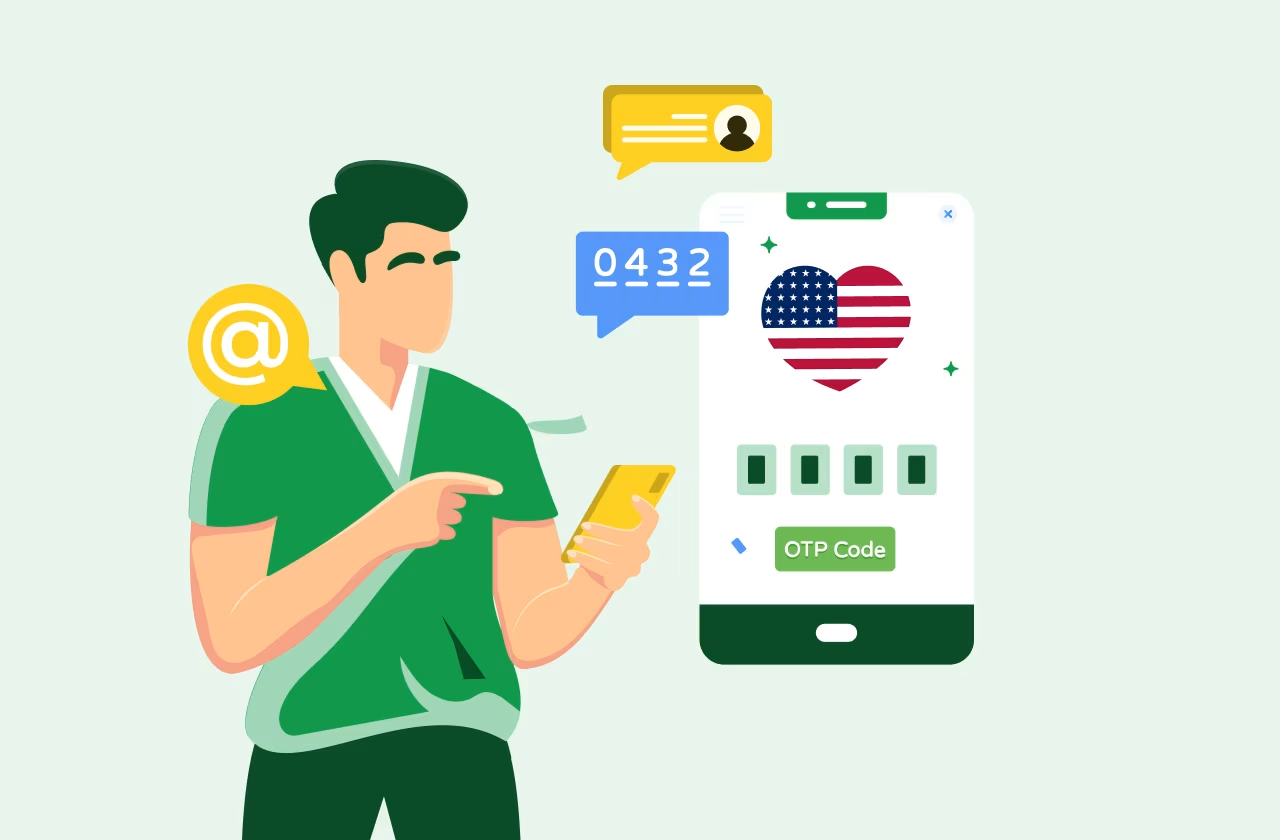
Two-factor authentication (2FA) is a security process that requires users to provide two different authentication factors to verify their identity. The two factors typically fall into three categories: something you know (e.g., a password), something you have (e.g., a mobile phone), and something you are (e.g., a fingerprint). By combining these factors, 2FA aims to provide a higher level of security than single-factor authentication.
Potential Downsides to Two-Factor Authentication
While 2FA enhances security, it has several potential downsides:
- User Inconvenience: Requiring users to provide an additional authentication factor can be seen as cumbersome, potentially leading to poor user experience and resistance to adoption.
- Reliance on Devices: 2FA often depends on users having access to their mobile devices or hardware tokens. Loss or theft of these devices can lock users out of their accounts.
- Phishing Attacks: Sophisticated phishing attacks can trick users into providing their authentication codes, rendering 2FA ineffective.
- SIM Swapping: Attackers can hijack a user's phone number through SIM swapping, intercepting SMS-based OTPs.
- Vulnerability to Social Engineering: Attackers can use social engineering techniques to trick users into providing their OTPs or other authentication factors.
- Cost: Implementing and supporting 2FA systems can be costly, especially for smaller organizations.
- Implementation Complexity: Setting up and maintaining 2FA can be complex and resource-intensive for organizations.
Web Application Security and 2FA
In the context of web application security, 2FA provides an additional layer of protection against unauthorized access. It helps prevent account takeovers, data breaches, and other security incidents. However, its effectiveness depends on the implementation and the robustness of the underlying systems. Weaknesses in web application security can still be exploited, even with 2FA in place.
Multi-Factor vs. Two-Factor Authentication
While 2FA uses two authentication factors, MFA incorporates more than two factors, offering enhanced security. MFA can include a combination of passwords, OTPs, biometrics, and hardware tokens. The key advantage of MFA over 2FA is its ability to provide multiple layers of defence, making it more challenging for attackers to compromise all factors simultaneously.
Multi-Factor Authentication Methods
Multi-factor authentication (MFA) extends beyond 2FA by incorporating additional layers of security. Common methods include:
- Passwords/PINs: Knowledge-based factors that users must remember.
- SMS or Email Codes: One-time passcodes sent to a user's mobile device or email. You can use an SMS verification service to enable the same.
- Authenticator Apps: Applications that generate time-based OTPs (e.g., Google Authenticator).
- Biometric Data: Fingerprints, facial recognition, or voice patterns.
- Hardware Tokens: Physical devices that generate OTPs (e.g., RSA SecurID).
Advantages of MFA Over 2FA in Combating Threats
MFA offers several advantages over 2FA in enhancing security:
- Increased Security Layers: By incorporating more than two factors, MFA provides additional layers of security, making it harder for attackers to compromise all factors.
- Reduced Impact of Phishing: With more authentication factors, the chances of phishing attacks succeeding are significantly reduced.
- Better User Experience: MFA solutions like biometric authentication can provide a seamless and user-friendly experience.
- Flexibility: MFA allows for a combination of various authentication methods, which can be tailored to the specific needs and security requirements of an organization.
Stats on Businesses Moving Away from 2FA Towards More Secure Systems
According to recent studies, a growing number of businesses are transitioning from 2FA to MFA and other advanced security measures:
- A report by Verizon found that 61% of organizations are now using MFA, up from 49% in previous years.
- Gartner predicts that by 2022, 60% of large and global enterprises and 90% of mid-sized enterprises will implement MFA.
- Research by Microsoft indicated that MFA can block 99.9% of account compromise attacks, highlighting its effectiveness over traditional 2FA.
Conclusion
While 2FA is a significant improvement over single-factor authentication, it is not without its limitations. User inconvenience, device dependency, and vulnerability to sophisticated attacks highlight the need for more robust security measures. Multi-factor authentication (MFA) offers enhanced protection by incorporating multiple layers of defence, making it more difficult for attackers to breach systems. As businesses increasingly recognize the limitations of 2FA, the shift towards MFA and other advanced security solutions is growing.



.avif)