You might not be able to signup with us right now as we are currently experiencing a downtime of 15 mins on our product. Request you to bear with us.

Home
Right Chevron Icon
Blog
Right Chevron IconRight Chevron Icon
Conversational Voice AI Agent Pricing: How to Reduce Total Spend

Conversational Voice AI Agent Pricing: How to Reduce Total Spend

Kashika MIshra

8
mins read

December 22, 2025

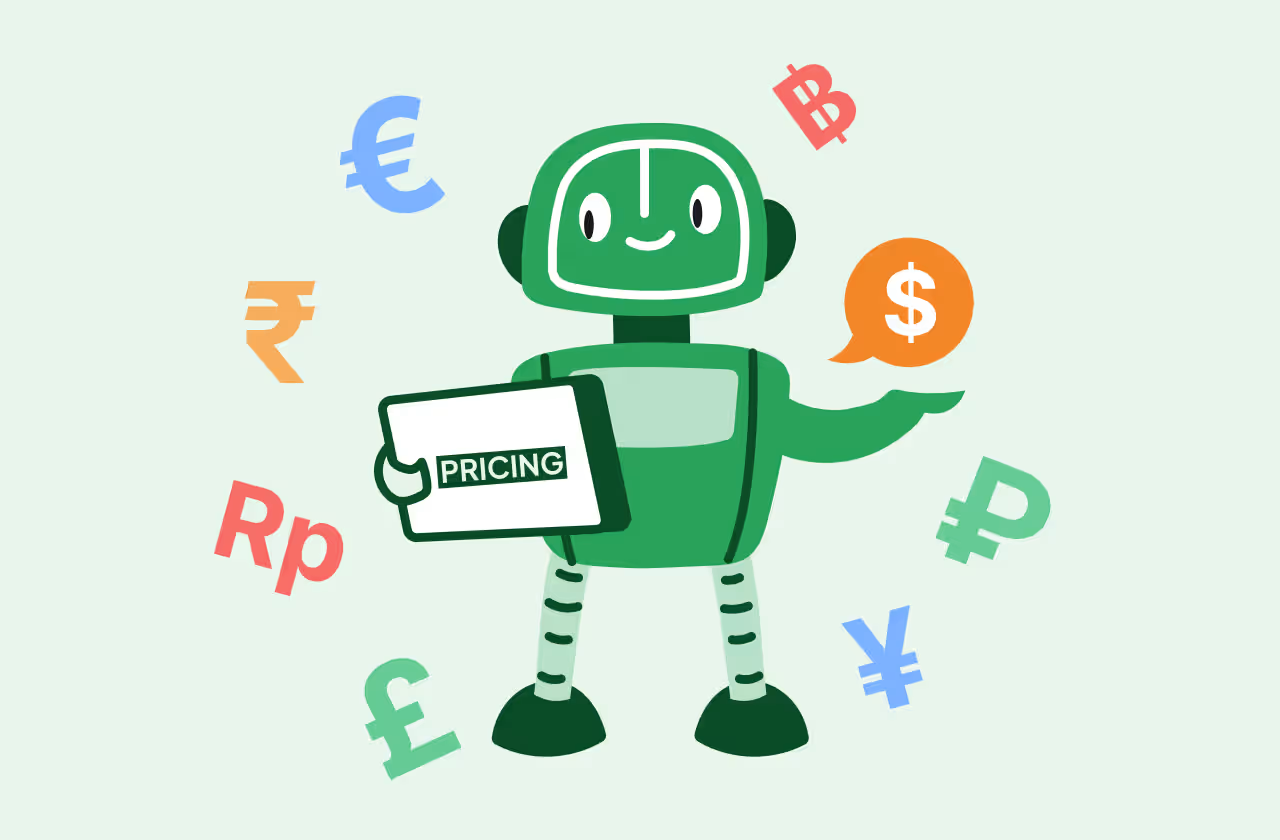
Illustration of a friendly green robot holding a “Pricing” sign, surrounded by global currency symbols, next to the text “Conversational AI Pricing Explained: Models, Hidden Costs, and How to Reduce Total Spend.

Key Takeways

Introduction 

If you have ever tried to compare the pricing of different Conversational AI or AI voice agent platforms, you already know how confusing it can be. One vendor charges per message, another charges per minute, another charges per token. Some give you a flat monthly fee but hide usage limits in the fine print. Others mark up LLM costs or charge extra for basic features.

And when you ask a simple question like “How much will this actually cost me?”, you rarely get a straight answer.

Let’s fix that.

This guide breaks down Conversational AI pricing in simple English. No fluff. No confusing terms. Just a clear explanation of what you are paying for, how vendors structure their fees, and how you can significantly reduce your total cost. If you are evaluating AI agents or voice automation for your business, this will help you make a confident decision.

Talk to our voice AI experts to see how you can get more value from your AI agent

(Also read: Conversational AI use cases for your business)

Quick Look: How Much Does Conversational Voice AI Agent Actually Cost?

Realistically, Conversational Voice AI agent pricing looks something like this:

  • AI Chat Agents: 0.002 to 0.02 USD per interaction
  • AI Voice Agents: 0.05 to 0.40 USD per minute
  • LLM Usage (OpenAI, Claude, etc): Depends on input and output tokens
  • Platform Subscription: 50 USD to more than 10,000 USD per month depending on scale
  • Implementation or Onboarding: Zero for plug and play platforms or up to 30k USD for enterprise setups

These are not exact vendor prices. They are typical ranges based on industry benchmarks.

The real cost you pay for AI depends on the model used, how long the interaction lasts, the channel (voice is more expensive than chat), and the routing logic the vendor uses.

The rest of this guide explains each part in detail.

Not sure how to get the most out of voice AI? Talk to our experts.

The Three Pricing Models You Will See Everywhere

Most conversational AI and AI voice agent providers use one or more of these three models.

Pay Per Message (for text based agents)

This is the most common for:

  • Web chatbots
  • WhatsApp agents
  • SMS bots
  • In app chat

Here you pay based on the number of messages or interactions. If you use SMS or WhatsApp, there may be separate channel fees depending on the country.

This model is ideal when your use cases are short and simple. For example:
Appointment Booking, Order updates, FAQ handling, OTP verification, reminders, account alerts.

Pay Per Minute (for voice AI agents)

Voice AI is more expensive than text AI because you pay for:

  • Speech to text
  • Text to speech
  • LLM reasoning
  • Telecom minutes
  • Call recordings
  • Carrier surcharges

This model is used for inbound and outbound calls such as:
Customer support, delivery updates, follow ups, payment collection, verification calls.

Voice pricing often shocks people because a 3 minute call can cost more than 15 to 20 chat interactions.

Token Based Pricing (LLM usage)

If the vendor uses OpenAI, Claude, Llama or other models, you pay for:

  • Input tokens (what the user says or types)
  • Output tokens (what the AI responds with)

Longer messages mean more tokens. Unexpectedly long responses can double your spend. Many vendors silently mark up LLM token costs. Others pass them through.

Token usage can be efficient or expensive depending on how the AI system is built.

What Actually Drives the Cost of Conversational AI?

Here are the key factors that influence your bill:

1. The AI Model You Choose

GPT 4o and Claude Opus are powerful but cost more. Smaller models like GPT 3.5 or Llama are cheaper but may be less capable for complex workflows.

Many buyers pay more simply because the vendor uses an unnecessarily large LLM for simple tasks.

2. The Channel You Use (voice costs the most)

  • Text chat: cheap
  • WhatsApp: moderate
  • Voice AI: most expensive

Voice agents involve multiple layers of AI and telecom. A short call can cost more than 10 to 20 chat exchanges.

3. The Complexity of Your Workflows

Simple tasks like FAQ answering or OTP verification use fewer tokens and lower processing power.

Complex tasks like refunds, KYC checks, or support issue resolution burn more tokens.

4. Vendor Markups

This is the big one.
Some vendors charge:

  • Markups on telecom
  • Markups on LLM tokens
  • Markups on WhatsApp templates
  • Fees for concurrency
  • Fees for knowledge base usage

A single markup can increase your bill by 20 to 60 percent without you noticing.

5. Traffic patterns

High concurrency or burst traffic can trigger premium charges, especially with enterprise vendors.

Hidden Costs Voice AI Providers Forget to Mention

These are the surprise charges that increase your cost of ownership.

  • Training and Setup Fees: Some platforms charge thousands for onboarding or implementation even though the AI agent still needs ongoing tuning.
  • Per Channel Fees: SMS rates vary by country. WhatsApp templates have approval fees. Voice calls have inbound and outbound rates. These hidden costs can add up quickly if you operate globally.
  • LLM Markups and Overuse Charges: Some vendors charge a markup above OpenAI or Anthropic pricing. If you generate large responses or use complex reasoning, the charges pile up fast.
  • Add Ons You Did Not Expect. Examples: Vector memory, Knowledge base syncing, Agent analytics, Human handoff. (Some vendors charge extra for these.)
  • Token Waste: Poorly optimized prompts or long responses result in higher bills. This is one of the biggest cost leaks.

Voice AI vs Text AI: Which One Costs More?

Voice AI is almost always more expensive for one reason: you pay for multiple AI layers at the same time.

During a 3 minute voice call, the system is doing:

  • Speech recognition
  • LLM reasoning
  • Text to speech
  • Call routing
  • Telecom processing

A 3 minute conversation can cost as much as 50 chat responses.

Text agents are far cheaper and ideal for most use cases unless voice is essential.

(Also read: Conversational AI for sales & lead generation)

How to Reduce Conversational Voice AI Costs Without Losing Quality

Here is the part most teams care about. These strategies work immediately.

  • Use the right model for the right task: Use big models only where required. Move simple tasks to smaller or fine tuned models.
  • Restrict response length: Shorter answers mean fewer tokens and lower voice minutes.
  • Cache smart responses: If the same user question appears often, avoid sending it to the LLM every time.
  • Use a knowledge base instead of long prompts: KB driven retrieval means drastically fewer tokens.
  • Move users from voice to chat when possible: It cuts cost by up to 80 percent.
  • Pick a vendor that does not mark up telecom or token usage: Transparent pricing prevents surprise bills.

How to Choose the Right Conversational Voice AI Vendor (Pricing Checklist)

Here is a simple checklist to evaluate vendors:

  • Do they show clear per message or per minute pricing
  • Do they mark up LLM token costs
  • Do they charge onboarding or setup fees
  • Can you choose your preferred AI model
  • Is WhatsApp or SMS pricing transparent
  • Do they offer free testing credits
  • Do they support token caching
  • Do they optimize for cost efficiency
  • Do you get full control over response length and tone

If a vendor cannot answer these questions clearly, think twice.

Summary: You Do Not Need to Overpay for Conversational Voice AI Agent

Conversational AI and voice AI agents can be powerful for support, sales, operations, and onboarding. But pricing varies widely and can feel confusing without a clear guide.

Now you know:

  • The three pricing models
  • Why voice costs more than chat
  • Hidden costs to avoid
  • How to reduce spend with simple optimizations
  • How to evaluate vendors using a cost based checklist

FAQs

Q) Can a voice AI agent schedule appointments automatically?
Yes, a voice AI agent can automatically schedule appointments by understanding the caller, checking availability, and confirming bookings in real time.Modern voice AI agents can handle the full flow—answering calls, collecting details, checking calendars, booking slots, and sending confirmations—without human intervention. Solutions like TalkNow are designed specifically for appointment scheduling, making them suitable for businesses that want to automate inbound and outbound booking calls reliably.

Q) How much does a voice AI agent cost?
The cost of a voice AI agent depends on call volume, usage time, and features such as integrations, call handling, and analytics.Most platforms charge based on actual usage rather than a fixed license fee. This makes voice AI cost-effective for businesses that want to reduce missed calls and manual scheduling. Tools like TalkNow typically offer flexible pricing models so companies can start small and scale as call volumes grow.

Q) Is voice AI priced per minute or per call?
Voice AI is usually priced per minute of conversation rather than per call.Per-minute pricing reflects the real resources used during a call, such as speech processing and AI reasoning. This model is common across voice AI platforms and gives businesses more predictable costs. Platforms like TalkNow use transparent usage-based pricing, which helps teams understand exactly what they are paying for as call volumes increase.

Ready to Get Started?

Build an effective communication funnel with Message Central.

Weekly Newsletter Right into Your Inbox

Envelope Icon
Thank you! Your submission has been received!
Oops! Something went wrong while submitting the form.
02271264300
phone-callphone-call