Key Takeways
- An SMS gateway lets your application send and receive messages globally through telecom networks using simple APIs or SMPP.
- Businesses use SMS gateways for OTP authentication, alerts, notifications, and marketing because SMS works everywhere, even without data or apps.
- Choosing the right gateway determines your delivery rate, routing quality, compliance success, and user experience.
- The fastest way to start sending SMS is via REST API integration, while high-volume traffic benefits from SMPP.
- Message Central provides direct carrier connections in 190+ countries to ensure higher deliverability, routing accuracy, and global reliability.
Introduction: Why SMS Gateways Still Matter
Even with apps, push notifications, and chat platforms everywhere, SMS communication remains a universal, phone-network-level channel everyone relies on. For many businesses (from e-commerce and fintech to healthcare, logistics, and customer support) SMS is the go-to tool for key communication: OTPs, alerts, reminders, order updates and notifications, and even marketing.
But sending SMS at scale (across networks and countries) needs more than a phone. You need a bridge that speaks telecom language and business logic. That bridge is the SMS gateway.
An SMS gateway makes it easy for your software, website or service to send (and receive) SMS just like sending an email, but via mobile networks. If you want to set up SMS fast and reliably, a gateway gets you up and running with minimal hassle.
(Don’t overspend on SMS. See real-time SMS pricing for 190+ countries)
What Exactly Is an SMS Gateway
An SMS gateway is a service (cloud-based, or on-premise) that connects your application or website to the global telecom network’s Short Message Service infrastructure.
In practice, this means:
- Your application calls the gateway’s API or uses a telecom protocol (like SMPP) to send a message, specifying the recipient number, message text, and sender information.
- The gateway formats and routes the message correctly, handles encoding (ASCII, Unicode, long messages), chooses the right mobile network path, and delivers the SMS via carrier networks to the recipient’s phone.
- If needed, the gateway also handles replies, delivery reports (“DLR”), message tracking, two-way messaging, and compliance with regional or carrier rules.
In short: an SMS gateway abstracts away the complexity of telecom networks and lets you send SMS messages at scale with code or SMS API calls.
Not sure where to begin? Chat with support and get SMS running today.
Why Use an SMS Gateway: Main Benefits
Using an SMS gateway brings several advantages over manual SMS sending or low-level telecom integration:
- Scalability & Throughput: Send hundreds or thousands of SMS per second. Useful for OTP bursts, alerts, or bulk campaigns.
- Global Reach: Reach customers across different carriers and countries without worrying about SMSC details or roaming complexity.
- Reliability & Delivery Reporting: Gateways often support delivery reports and retry mechanisms if initial delivery fails.
- Ease of Integration: Simple REST API or standard telecom protocols (like SMPP) mean quick setup. No need for physical SIMs or modems.
- Compliance & Regulatory Handling: Good gateways help manage regional rules, sender-IDs, opt-outs, and other compliance needs; crucial for markets like the U.S. or India.
- Cost & Time Efficiency: No manual overhead of using phones, SIMs, or hardware; pay per message or via monthly plans.
How to Get Started With SMS Gateways: A Step-by-Step Setup Guide
Here’s a quick path to get SMS up and running fast:
- Choose an SMS Gateway Provider: Prefer one with global carrier connections, strong uptime, delivery reporting, compliance support, and easy APIs.
- Register / Create Account & Get API Credentials: Signup, get API key or SMPP credentials depending on gateway.
- Decide on Sending Method: REST API or SMPP
- For small to moderate volume and ease, use REST/HTTP API.
- For high volume (bulk alerts, OTP bursts), use SMPP for better throughput and performance.
- Integrate with Your Application: Use SDK or HTTP calls to send messages (destination number, message body, sender-ID).
- Test Delivery & Delivery Reports: Send to test numbers, check receipt, verify message encoding, handle long messages and non-English text if needed.
- Implement Opt-out / Compliance Features: Include unsubscribe mechanisms if sending marketing SMS; honour regional and carrier regulations (carrier-opt-out, consent, sender-ID rules).
- Monitor, Log & Scale: Track delivery status, failures, retries, throughput; scale as per load and maintain usage logs for audit/compliance.
Ready to start with an SMS Gateway? Sign up and go live today.
Common Use Cases Where SMS Gateways Shine
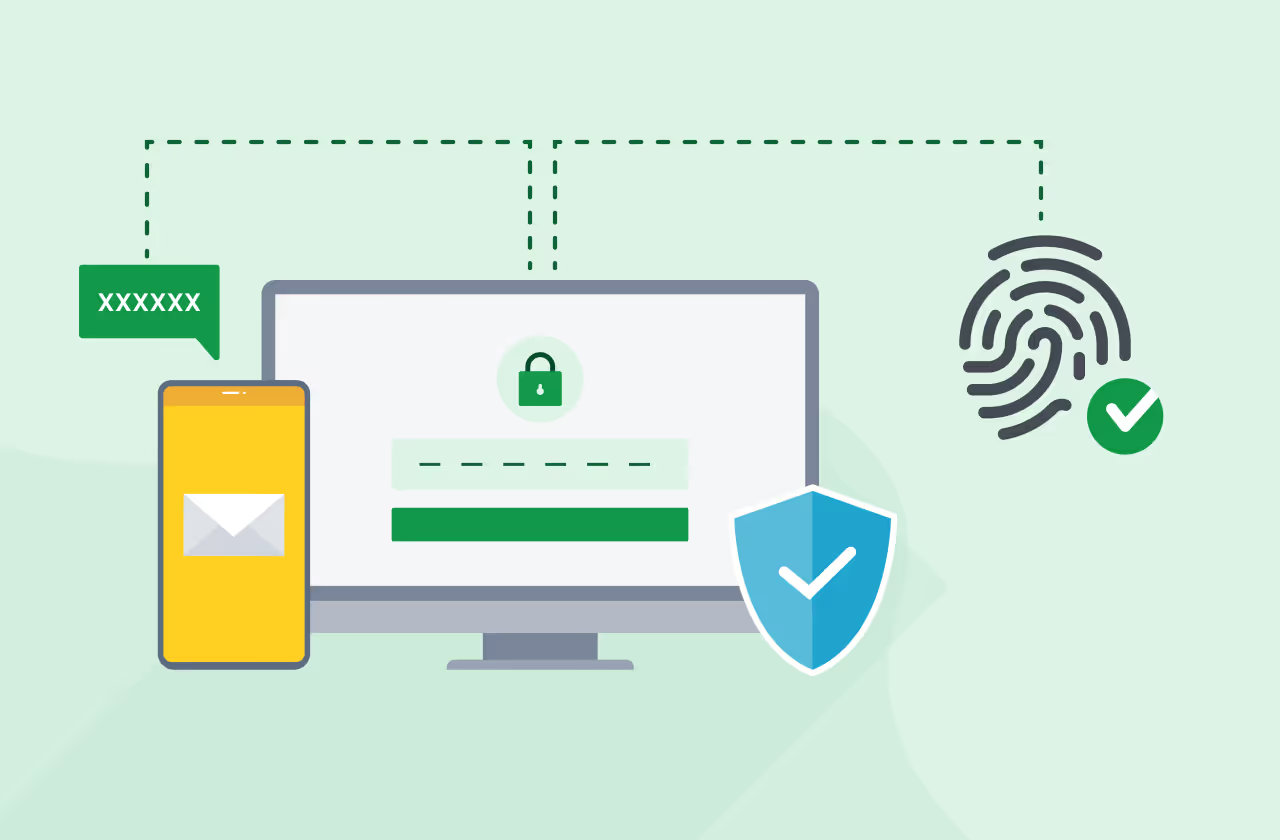
- Two-Factor Authentication (2FA) / OTPs: Secure login, account verification, password reset.
- Critical Alerts & Notifications: Banking alerts, fraud alerts, system outages, appointment reminders.
- Marketing & Promotions: Deal alerts, sales, offers; especially when open rates matter more than click-through.
- Global Reach Communications: When your user base is spread across countries; SMS works even without smartphone or data connection.
- IoT / Device Alerts / Legacy Device Notifications: For devices or users without data, SMS remains reliable fallback.
What to Watch For: Limitations & Best Practices
Before you rely solely on SMS, be aware of potential challenges:
- Carrier and Regional Compliance Rules: Many countries and carriers enforce rules: sender-ID restrictions, opt-in / opt-out requirements, regulatory registrations. Non-compliance can block or filter messages.
- Message Size & Encoding Issues: SMS limits: 160 ASCII characters per message (less for Unicode). Long messages or Unicode (non-Latin languages, emojis) need concatenation or may fail/be split. Always test.
- Delivery Delays, Network Variability & Failures: SMS isn’t instantaneous worldwide; some carriers may throttle or block high-volume traffic. Use fallback or retry logic.
- Cost for High Volume or International Delivery: Bulk campaigns or cross-country SMS can add up. Monitor usage and optimize message volume.
- No Reliability Guarantees Like Email / Push, Delivery may fail silently: Use delivery reports, retry logic, fallback notifications for critical messages.
How to Choose the Right SMS Gateway Provider: Quick Evaluation Checklist
Use this checklist when evaluating gateways:
- Global carrier coverage and direct-to-carrier connections (not just low-tier aggregators)
- Support for both HTTP-API and SMPP (for flexibility)
- Delivery reports (DLR), retry support, sender-ID management
- Compliance support (opt-in/out, sender-ID approval, regional regulations)
- Unicode and long-message support, plus international number formatting
- Transparent pricing and usage logs
- Uptime and reliability (SLA, redundancy, load balancing)
- Customer support and fallback routing for message failures
Evaluating SMS providers? Compare us to Twilio before you make a decision.
Conclusion: SMS Gateway- A Powerful Foundation When Done Right
SMS is one of the few communication channels that works across all phone types and connectivity scenarios, from basic feature phones to smartphones and IoT devices. For businesses that value reliability, reach, and simple integration, an SMS gateway is not optional, it is the foundation of trustworthy, scalable messaging.
Getting started is fast: pick a reputable gateway like Message Central, integrate via REST API or SMPP, test delivery and encoding, implement compliance and opt-out flows, and monitor delivery reports and retries. Over time, optimize routing, sender IDs and fallback channels to maintain performance and user trust.
If you want a provider that simplifies this entire stack, consider Message Central. It offers direct carrier connections across 190+ countries, built-in compliance and routing logic, and industry-leading deliverability practices that help keep critical OTPs, alerts and notifications arriving where they need to. Paired with good message design and monitoring, the right gateway turns SMS from a point solution into a resilient, global communication backbone.
Reach users in 190+ countries with one API. Try Message Central today.
FAQs
What is the best SMS gateway for businesses in the USA?
The best SMS gateway in the USA is one that supports 10DLC, offers high-quality A2P routes, fast delivery, and strong compliance handling. Message Central’s SMS gateway provides direct US routes, high deliverability, and instant API integration for alerts, OTPs, and notifications.
Do I need 10DLC registration to send SMS in the USA?
Yes. For business messaging in the USA, 10DLC registration is mandatory. Message Central provides pre-approved templates and handles registration so you can start sending high utility OTP SMS immediately while we help you register for 10DLC in the background.
What is the best alternative to Twilio for SMS in the USA?
Message Central is a strong Twilio alternative, offering direct carrier routes, lower pricing, faster delivery, and built-in compliance for 10DLC, A2P, and enterprise-scale messaging.