


Key Takeways
- A phone number verification API programmatically confirms a user controls a given phone number, typically by sending a one-time password (OTP) via SMS, WhatsApp, or voice and validating the entered code.
- Modern verification APIs handle global E.164 normalization, channel selection, operator routing, fraud protection, and regulatory compliance (DLT in India, 10DLC in U.S., TRA in UAE) out of the box.
- Phone verification is the cheapest, fastest defense against fake signups and bot abuse, meaningfully harder to mass-fabricate than email.
- Multi-channel APIs that auto-fall-back from one channel to another keep delivery success near 99% in production.
- For most teams, integration takes under a day with drop-in SDKs and free test credits; typically 30-60% lower TCO than building it in-house.
Every business that handles user signups, payments, or sensitive transactions runs into the same problem: how do you know the person on the other side of the screen is real, reachable, and not a bot? In 2025, IBM's Cost of a Data Breach Report pegged the average cost of a single breach at $4.88 million, and a non-trivial share of those breaches start with a fake or stolen identity slipping past signup. Phone number verification of users has become one of the simplest, most cost-effective defenses — and a phone number verification API is how modern teams ship it in days, not months.
This guide explains exactly what a phone number verification API is, how it works under the hood, what features matter when you're choosing one, and where it fits in your authentication and onboarding stack.
Definition: What is a Phone Number Verification API?
A phone number verification API is a developer-facing service that programmatically confirms a user owns a given phone number; typically by sending a One-Time Password (OTP) over SMS, WhatsApp, or voice call and validating the code the user enters back. The API exposes a small set of endpoints (usually "send code" and "verify code") that any web or mobile application can integrate in a few hundred lines of code, abstracting away the complex telecom routing, number-format validation, and global delivery logistics underneath.
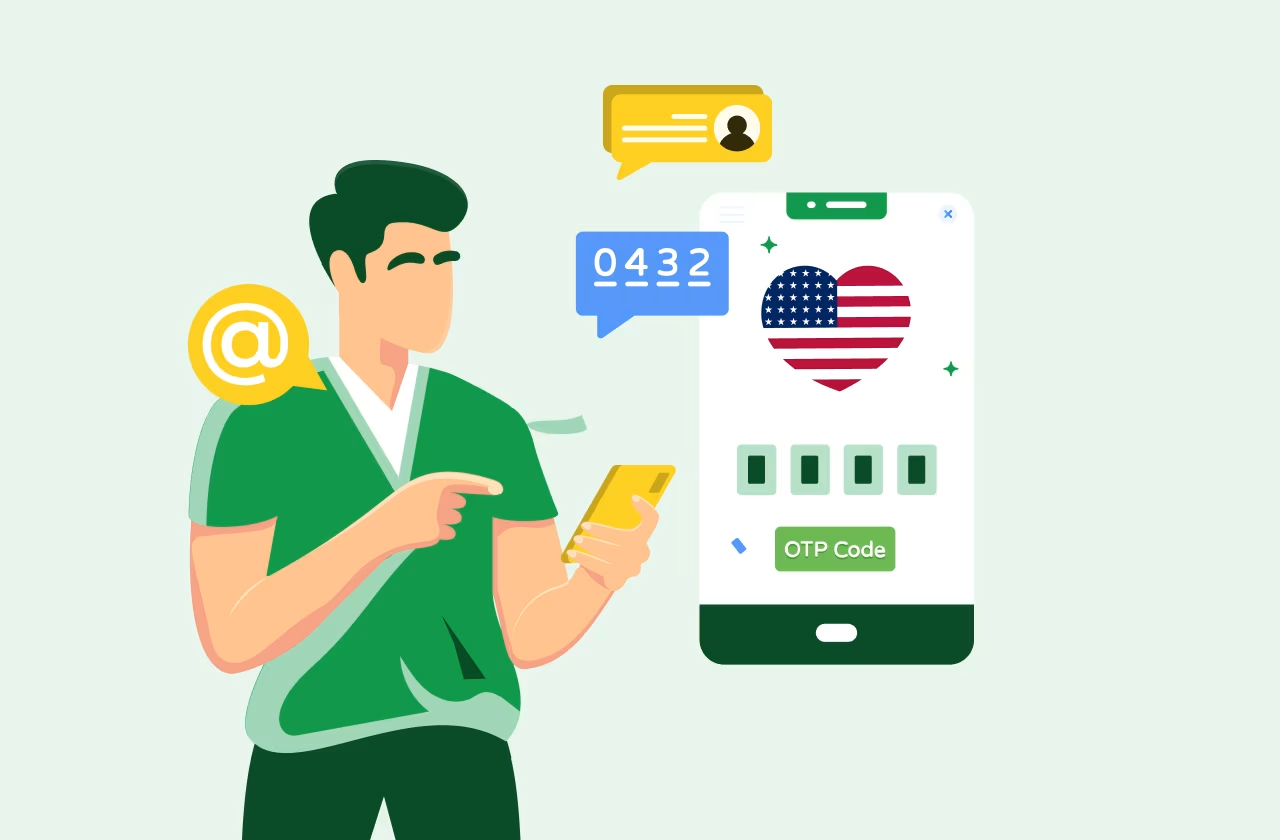
In practical terms, when a user enters their phone number on your signup form, your backend calls the API. The OTP API generates a code, picks the optimal delivery channel and route, sends the message, and returns a verification ID. When the user types the code back into your app, you call the API again to verify; and you get a definitive yes or no on whether that user actually controls that number.
Why Businesses Use Phone Verification APIs
The "why" comes down to four overlapping problems that phone verification solves better than most alternatives.
Stopping fake signups and bots
Email verification has been gamed for years: disposable inboxes are free, scriptable, and infinite. Phone numbers, especially mobile numbers, have a cost (a SIM, a device, a monthly plan), which makes them a meaningfully harder credential to mass-fabricate. Marketplaces, fintech apps, and any platform with a free tier rely on phone verification to keep fraud-to-good-user ratios sane.
Protecting accounts with two-factor authentication
The U.S. National Institute of Standards and Technology's SP 800-63B Digital Identity Guidelines recognizes SMS-based OTP as a valid (if no longer "preferred") second-factor authenticator for most authentication assurance levels. For consumer-facing apps where the alternative is no MFA at all, phone-based 2FA materially reduces account takeover.
Building reachable user bases
A verified mobile number is a persistent communication channel for transactional alerts, shipping updates, password resets, and (with consent) marketing. Marketers and product teams treat it as one of the highest-value first-party data points after email.
Meeting regulatory and platform requirements
WhatsApp Business, Apple's App Store, payment processors like Stripe Identity, and most banking regulators expect Know Your Customer (KYC) flows that include verified contact information. Phone verification is often the cheapest way to satisfy that bar.
How Phone Number Verification Works (The Short Version)
At a high level, a phone number verification API runs four steps every time:
- Number normalization. The user-entered number is parsed against the global E.164 international format (e.g.,
+14155552671) and validated against the country's number plan to filter out impossible numbers before you spend money sending a message. - Code generation and delivery routing. A short numeric code (typically 4–6 digits) is generated, hashed, and stored. The API picks the optimal delivery channel (SMS, WhatsApp, or voice) and the optimal carrier route based on country, sender rules, and cost.
- Delivery. The message is sent via the chosen route. Good APIs track delivery status callbacks from operators and retry across channels if the first attempt fails.
- Verification. The user enters the code in your app. Your backend calls the verify endpoint. The API checks that the code matches, hasn't expired, and hasn't been used — then returns a verified status to your app.
We dig into each step (and the failure modes worth knowing about) in our step-by-step guide on how phone number verification works.
Key Features of a Phone Verification API
Not all phone verification APIs are equal. The features that separate a serviceable API from one you can build a business on:
Multi-channel delivery (SMS + WhatsApp + Voice)
SMS is the universal default, but in markets like India, Indonesia, and Brazil, WhatsApp delivers faster and at a lower cost. A modern API auto-falls-back from one channel to another when delivery fails, so the user gets the code regardless of which channel works on their network that day.
Global coverage with smart routing
Sending an OTP to a French mobile, a Saudi number, and a US toll-free number each requires a different operator route, sender ID rule set, and compliance posture. The best phone verification API maintains direct operator connections in 200+ countries and route automatically.
Fraud and abuse protection
Phone-pumping fraud (SMS pumping or "International Revenue Share Fraud" — well documented by the GSMA Fraud and Security Group) costs apps that send OTPs without protection real money. Look for built-in rate limiting, suspicious-number blocking, and traffic-pattern anomaly detection.
Clean SDKs and webhooks
Drop-in libraries for Node, Python, Java, PHP, Go, and Ruby cut integration time from days to hours. Webhooks for delivery status make analytics and reporting reliable.
Regulatory readiness
India's DLT registration, the U.S. 10DLC framework, the UAE's TRA approvals, and the EU's GDPR consent rules all touch how OTPs can be sent. APIs that handle this for you (or skip it where compliantly possible) save weeks of legal work.
Free test credits without a credit card
Practical, but matters: any API you can't load-test before committing budget is a black box. VerifyNow for instance gives free test credits with no credit card so you can benchmark delivery and latency on your real users before you commit.
Phone Verification vs OTP Verification — Are They the Same Thing?
Almost, but not quite. Phone number verification is the goal: proving someone owns a number. OTP verification is the most common method to achieve it. An OTP is a one-time password: a short, time-limited, single-use code. You can verify a phone number by other methods too: silent network authentication, missed-call verification, push-based verification — but in 2026, OTP over SMS or WhatsApp is still the most widely deployed mechanism because it works on every phone, in every country, without an app install.
If you're weighing the trade-offs between OTP-based phone verification and other approaches, see our deeper comparison: OTP Verification vs Phone Number Verification.
Use Cases Across Industries
Phone verification APIs show up across nearly every industry that handles user accounts or money. The most common deployments:
Fintech and digital banking
Account opening, funds transfers, login MFA, and high-value transaction confirmations. Indian fintechs in particular rely heavily on phone-based verification because the Reserve Bank of India's KYC framework explicitly recognizes mobile-number-linked Aadhaar verification.
E-commerce and marketplaces
Buyer and seller signup, order confirmations, and payment OTP. Marketplaces like ride-hailing or P2P platforms verify both sides of every transaction, often with SMS OTP at multiple steps.
Healthcare
Patient identity verification before sharing medical records, appointment reminders, telemedicine session join links. HIPAA-aware APIs handle the encryption-in-transit and audit-logging requirements out of the box.
Logistics and delivery
Driver onboarding, customer pickup confirmation, OTP-on-delivery for high-value shipments — common across Amazon, Flipkart, and most e-grocery platforms.
Education and EdTech.
Student account registration, parent verification for under-18 accounts, and exam-taker identity verification. GSMA's connectivity research shows that mobile-first authentication is especially critical in markets where students may not have a personal email but always have a phone.
SaaS and developer platforms
Free-tier abuse prevention, paid-tier signup verification, and programmatic 2FA on admin actions.
Our complete guide to phone verification API use cases walks through implementation patterns for each industry.
Benefits of Using a Phone Verification API
The case for using an API rather than building verification yourself comes down to five concrete wins.
Speed to launch
A modern verification API integrates in under a day. Building it yourself involves operator contracts in every country you serve, sender ID registrations (DLT in India, 10DLC in the U.S., TRA in UAE), an OTP generation and storage system, retry logic, and 24/7 delivery monitoring. That's a six-month project at minimum.
Higher delivery and conversion rates
Specialized providers maintain multiple operator routes per country and dynamically pick the highest-performing path. Auth0's research on authentication conversion shows even small drops in OTP delivery success translate directly to lost signups.
Compliance handled
The API takes care of opt-in tracking, consent storage, region-specific sender rules, and audit logs that regulators will eventually ask for.
Lower total cost
Bulk operator pricing through a CPaaS like Message Central is materially cheaper per OTP than retail rates a single business can negotiate. The cost-per-verified-user usually comes out 30–60% lower than DIY.
Scale on demand
Traffic spikes — flash sales, product launches, viral moments — would crush a self-built system. A managed API absorbs the spike with the operator routes already provisioned.
FAQs
How long does it take to integrate a phone number verification API?
For most teams, an MVP integration with a modern verification API takes between 30 minutes and 4 hours, depending on whether you use a drop-in SDK or call the REST endpoints directly. A production-ready integration with retry logic, fallback channels, and proper error handling typically takes one engineering day.
Is SMS-based OTP still secure in 2026?
SMS OTP is no longer the strongest authenticator available — the NIST SP 800-63B guidelines classify it as "restricted" for high-assurance contexts because of SS7 and SIM-swap risks. But for consumer apps where the realistic alternative is no second factor at all, SMS OTP verification remains a meaningful security upgrade. Pair it with risk-based authentication and device binding for higher-stakes flows.
What's the difference between phone number verification and phone number validation?
Validation just checks whether a number is syntactically correct and possibly whether it's a real, in-service number — usually via a number-lookup API. Verification proves ownership by sending a code only the legitimate owner can receive. Validation is a $0.001 lookup; verification is a real challenge.
How much does phone verification cost?
Cost per OTP varies widely by country — from under $0.005 per SMS in markets like India to over $0.06 per SMS in some European countries. Most phone verification APIs charge per successful verification, and pricing usually scales down with volume. Free tiers (typically 100–1,000 free OTPs) are the norm.
Can I use WhatsApp for phone verification instead of SMS?
Yes, and increasingly you should. WhatsApp OTP verification is faster and cheaper in many countries, and it sidesteps SMS-specific failure modes like operator filtering and SIM-swap fraud. Most modern verification APIs (including VerifyNow) support SMS, WhatsApp, and voice OTP in a single endpoint with automatic fallback.
Ready to Add Phone Verification to Your App?
If you're evaluating phone number verification APIs for your business, the fastest way to get a feel for delivery speed, code-language fit, and cost is to test on your own users. Sign up for VerifyNow — you get free test credits with no credit card required, support for SMS + WhatsApp in a single API, and 200+ country coverage from day one.



.avif)